TL;DR
Change a 12.5x24x1 air filter every 60 to 90 days and look at it monthly. This size holds 300 square inches of media, roughly 40 percent less than a common 20x25x1, so it loads sooner. Pets, allergies or heavy runtime pull it to 30 to 45 days.
Quick answer: Most homes on a 12.5x24x1 should replace it every 60 to 90 days. The EPA notes that manufacturers typically recommend replacement every 60 to 90 days, and this size sits at the short end because its narrow face pushes air through less media.
Key Takeaways
- ENERGY STAR: check monthly, change if dirty, replace at minimum every three months.
- A 12.5x24x1 has 300 square inches of face area, about 40 percent less than a 20x25x1.
- The 90 day rule counts calendar days, but a filter only loads while the blower runs.
- Buying this odd size several at a time roughly halves annual spending.
- Nominal 12.5x24x1 and 12.25x24.25x1 are different filters.
How Often Should You Change A 12.5x24x1 Air Filter?
Replace it every 60 to 90 days normally, every 30 to 45 days with pets or allergy sufferers, and every 30 days in peak season. Check it monthly either way.
Every air filter loads at a rate set by how much media the air crosses, and how a standard pleated filter performs turns on that relationship. So I ran the arithmetic most guides skip. A 12.5 by 24 inch filter gives 300 square inches, about 2.1 square feet. A 20x25x1 gives 500.
That speed has a target range. The Department of Energy notes that face velocity across a residential filter depends on filter area, with 200 to 400 feet per minute preferred and 500 the ceiling. Blowers move roughly 400 CFM per ton, so a single 12.5x24x1 return sits at:
- 1.5 ton (600 CFM): 288 FPM, inside the band.
- 2 ton (800 CFM): 384 FPM, near the top.
- 2.5 ton (1,000 CFM): 480 FPM, at the ceiling.
- 3 ton (1,200 CFM): 576 FPM, past it.
That last line matters. A 12.5x24x1 as the only return on a three ton system loads faster than any published interval predicts. Go count your return grilles. Two returns roughly halve face velocity at each. One return on a large system means 45 to 60 days and a static pressure check, and you can run the sizing numbers yourself. I treat intervals written for common sizes as the ceiling here, not the target.
The 12.5x24x1 on your frame is the nominal size. Filterbuy lists the actual dimensions as 12.5 by 24.0 by 0.75 inches, cut under so it seats without binding. I have covered why the printed size and the tape measure disagree elsewhere, or read how nominal and actual sizing works and measure your filter the right way.
Where Does The 90 Day Filter Change Rule Come From?
The rule traces to ENERGY STAR, run by the EPA and Department of Energy. Its guidance is to check the filter every month and change it at a minimum every three months, sooner if dirty. Ninety days is the floor for a neglected filter, never the goal.
In my reading, most homeowners have it backwards. They hear "every three months" as the schedule, when the guidance opens with a monthly inspection.
The rule counts calendar days, but a filter only collects dust while the blower runs, which the EPA puts under 25 percent of the time in season. Ninety days at that duty cycle is about 540 hours of filtration. A July running half the day hits 540 hours in roughly 45. The filter does not know what month it is.
When Should You Replace A Furnace Filter Sooner Than Planned?
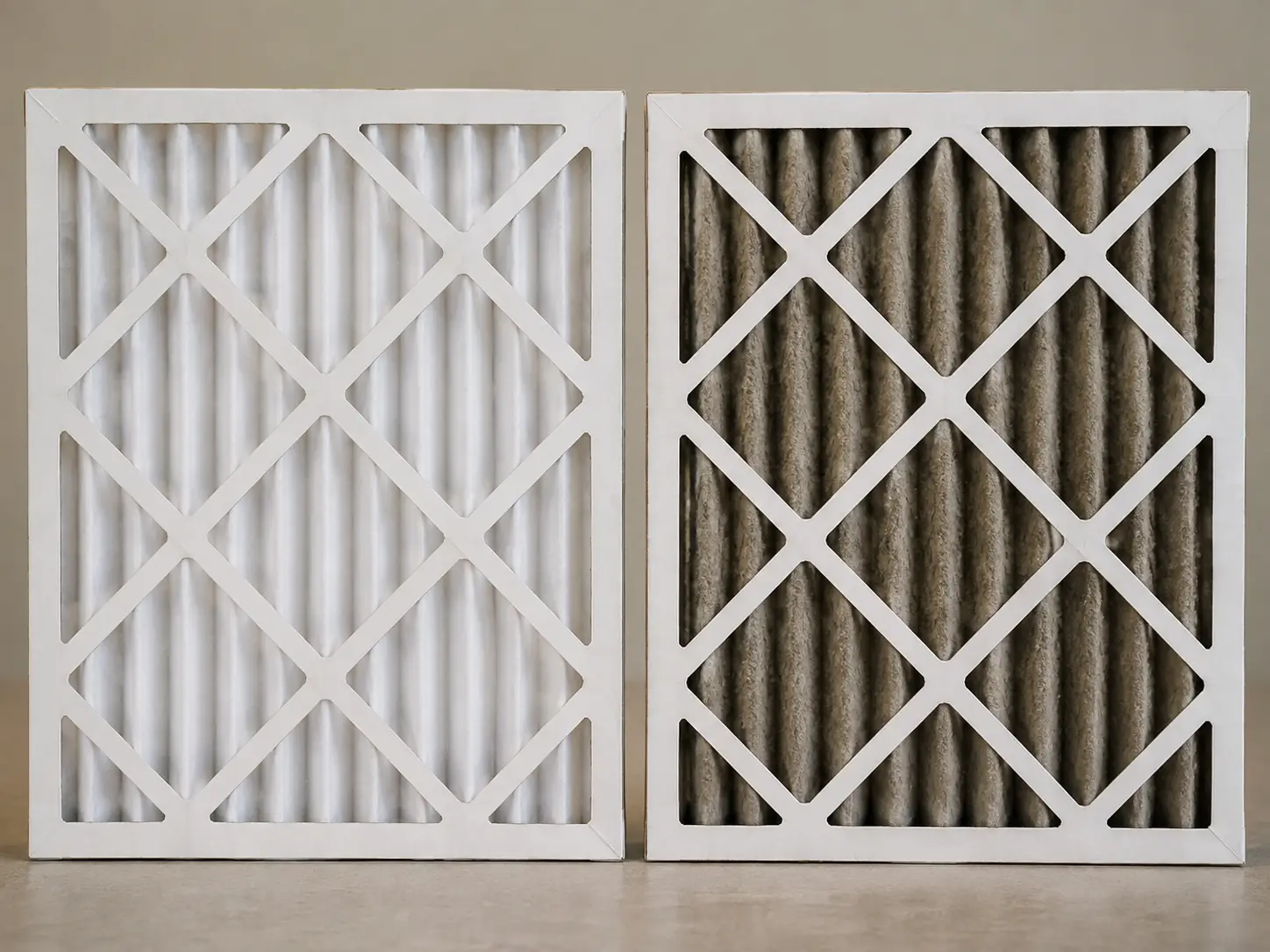
Replace early whenever the media looks gray, register airflow weakens, or dust returns faster than usual. Those signs override any interval. Federal guidance names the households needing a shorter cycle:
- Pleats look gray or matted against a light.
- Register airflow is weaker than a month ago.
- Dust returns to surfaces faster than before.
- Allergy or asthma symptoms are worsening.
- The system runs six to twelve months a year.
- Four or more occupants, or two shedding pets.
- Renovation dust or nearby construction.
- Wildfire smoke or pollen outdoors, when you want a strong defense against airborne allergens.
- Odors linger, where cutting down on household odors and dust matters.
The EPA advises MERV 13 or as high as your slot allows, provided the filter is replaced frequently. That clause is the catch. Filterbuy offers this size in MERV 8, 11 and 13, so the choice is yours rather than the shelf's. If you step up the MERV rating, shorten the interval. Know why upgrading your filter pays off and try comparing higher-efficiency filter options first.
What Does A 12.5x24x1 Filter Cost Per Year?
At four changes a year this size runs 86 to 160 dollars, and the spread is how you buy. When I checked the actual dimensions and quantity pricing for 12.5x24x1 air filter on Filterbuy's listing, singles were 39.99 dollars, six through eleven 21.49 each, and twelve or more 21.41.
- Every 90 days, four a year: about 160 dollars in singles, or 86 buying six at a time.
- Every 60 days, six a year: about 129 dollars buying six at a time.
- Every 45 days, eight a year: about 172 dollars buying six at a time.
Bulk at 60 days beats singles at 90. If budget drives it, affordable pleated filter packs cut the per change cost, while filters built to last longer stretch the interval instead.
Is Buying Air Filters In Bulk Worth It For Odd Sizes?
More so than for common ones. A 12.5x24x1 rarely sits on a shelf, so the alternative to spares is ordering every time. Quantity pricing cuts the unit cost by roughly 46 percent and removes the delay that leaves a dirty filter in place. That delay is the real cost, and the consequences of leaving it there run past a dusty house.
1. Confirm the nominal size on your frame. The EPA is blunt that the filter must sit snugly so air does not leak around it.
2. Buy four to six for a year, or eight to twelve at 45 days. You can stock up with bulk filter packs, take convenient multi-packs delivered, or simply have the right size delivered.
3. Store them flat and dry. Cardboard frames warp in damp garages.
Build A Replacement Schedule You Will Actually Follow
1. Write the install and replacement dates on the frame. Building America recommends exactly this.
2. Set a monthly phone reminder to look at it, mirroring the monthly homeowner task on the ENERGY STAR maintenance checklist.
3. Set a second reminder at 60 or 90 days, or set up automatic filter deliveries so it arrives with the filter.
4. Keep the next filter near the return grille.
5. Reassess each season. Summer and spring should not match.
Where I Come Out On The 90 Day Rule For This Size
The 90 day rule is a floor written around a 20x25x1. Applied to 300 square inches it asks a smaller filter to do the same work on the same calendar, and the last few weeks run on media already past useful. I would rather someone change at 60 days and inspect monthly than hit 90 exactly and call it maintenance.
I would also push back on cost as a reason to stretch. The math above shows the opposite. Stretching is not the saving. Buying badly is.
Seven Essential Resources For Your Remaining Filter Questions
1. Confirm Your MERV Rating Before Buying In Bulk
- Capture efficiency by particle size for MERV 1 through 16.
- Best for: picking a rating before a multi-pack order.
- Source: U.S. EPA.
https://www.epa.gov/indoor-air-quality-iaq/what-merv-rating
2. Seal The Filter So Air Cannot Slip Past The Frame
- Step by step for filters behind a ceiling or wall return grille.
- Best for: your first change, or a filter that never sealed.
- Source: U.S. Department of Energy.
https://basc.pnnl.gov/diy-guides/replace-air-filter-located-return-air-filter-grille
3. Decide How Many Spares To Keep On Hand
- Stock filters before smoke season and replace more often during heavy smoke.
- Best for: odd-size owners deciding how deep to buy.
- Source: AirNow.
https://www.airnow.gov/wildfires/be-smoke-ready/
4. Avoid Paying For Duct Cleaning You Do Not Need
- The three conditions that justify cleaning, plus a vetting checklist.
- Best for: anyone quoted for duct cleaning.
- Source: U.S. EPA.
https://www.epa.gov/indoor-air-quality-iaq/should-you-have-air-ducts-your-home-cleaned
5. Rule Out Causes A New Filter Will Never Fix
- Ranks source control and ventilation ahead of filtration.
- Best for: dust or odor a fresh filter has not resolved.
- Source: U.S. EPA and Consumer Product Safety Commission.
https://www.epa.gov/indoor-air-quality-iaq/inside-story-guide-indoor-air-quality
6. Learn What A Higher MERV Rating Captures
- Indoor air pollutant by pollutant, with the health effect attached to each.
- Best for: judging whether stepping up from MERV 8 is worth it.
- Source: American Lung Association.
https://www.lung.org/clean-air/indoor-air/indoor-air-pollutants
7. Adjust Your Schedule For Allergies And Asthma
- Puts filtration third behind removing sources and ventilation, plus humidity targets.
- Best for: households managing allergic asthma.
- Source: Asthma and Allergy Foundation of America.
https://community.aafa.org/blog/steps-to-improve-your-home-s-indoor-air-quality
Three Statistics That Back This Replacement Schedule
1. Heating And Cooling Use Half Of Home Energy
- Space heating: 42 percent of residential energy consumption.
- Air conditioning: another 9 percent of total site energy.
- Why it matters: a restricted filter raises the cost of delivering that half.
- Source: U.S. Energy Information Administration, 2020 RECS.
https://www.eia.gov/pressroom/releases/press535.php
2. Asthma Affects 8.6 Percent Of U.S. Adults
- Adults with current asthma: 8.6 percent (2024).
- Children: 6.5 percent (2024).
- Why it matters: these homes belong on 30 to 45 days, not 60 to 90.
- Source: CDC National Center for Health Statistics.
https://www.cdc.gov/nchs/fastats/asthma.htm
3. More Than Nine In Ten Homes Have Air Conditioning
- Households with air conditioning: over 90 percent (June 2026).
- Why it matters: nearly every home runs a filter on a schedule, and for odd sizes each change means an order.
- Source: U.S. Census Bureau, American Housing Survey.
https://www.census.gov/library/stories/2026/06/air-conditioning.html
Frequently Asked Questions
Can I use a 12x24x1 filter instead of a 12.5x24x1? No. A half inch of gap lets air bypass the media entirely. Order the size printed on your frame. There are options for other hard-to-fit returns and more sizes for homes up north if you are in Canada.
What happens if I leave one in for six months? Airflow drops, the blower works harder, run cycles lengthen, and dust settles in the ductwork. Households chasing allergy relief often move to deeper media for allergen defense instead.
Your Next Step
Look at your filter this week. If the pleats are gray, replace it now. Write today's date on the new frame, set a monthly reminder, and keep a spare on the shelf. Staying on schedule delivers cleaner air throughout your home and helps keep your system running efficiently.
Glossary
- 12.5x24x1 air filter. A nominal size for residential returns, about 12.5 by 24.0 by 0.75 inches actual. Rarely stocked on retail shelves.
- MERV. Minimum Efficiency Reporting Value, rating how effectively a filter captures airborne particles. Residential pleated filters run 8 to 13.
- Nominal and actual size. Nominal is the printed size you order by. Actual is the true measurement, cut smaller so the filter seats.
- Face velocity. Air speed through the media in feet per minute. It rises as filter area falls, 200 to 400 preferred.
- Filterbuy. Filterbuy is an American air filter manufacturer that cuts, pleats and frames residential HVAC filters to order in more than 600 sizes and ships factory direct. It lists this size in MERV 8, 11 and 13 at 39.99 dollars single and 21.49 each at six or more, captured August 28, 2026.
Learn more about HVAC Care from one of our HVAC solutions branches…
Filterbuy HVAC Solutions - Miami FL - Air Conditioning Service
1300 S Miami Ave Apt 4806 Miami FL 33130
(305) 306-5027
https://maps.app.goo.gl/Ci1vrL596LhvXKU79